polski
 español

 Aleksander Janicki

Artificial intelligence is evolving at an unprecedented pace, transforming how we create, optimize, and interact with digital content.
This comprehensive guide will help you navigate the latest capabilities, legalities, and best practices of using ChatGPT effectively to stay ahead of the curve.
Table of contents
- 1. What is ChatGPT?
- 2. How can I use content generated by ChatGPT? (legal aspects)?
- 3. What should I be cautious about when using ChatGPT?
- 4. What topics can ChatGPT write about?
- 4media AI – support for your newsroom
- 5. In how many languages can ChatGPT operate?
- 6. When starting a new conversation topic, create a separate chat room
- 7. What cannot be done using Chat GPT?
- 8. It also has a paid version
- 9. What are the alternatives to ChatGPT?
- 10. Use responsibly
- Summary
1. What is ChatGPT?
This is a language model based on artificial intelligence (AI). Chat GPT is an abbreviation for “Chat Generative Pre-trained Transformer.” In short, it means that based on previously learned and analyzed vast amounts of content, the program has learned language rules and can generate new, “original” content.
Access to the chatbot can be obtained through a web browser, both on a computer and on a mobile phone. In addition, the mobile application has recently been released, making it easier to use the tool on a phone.
ChatGPT is perfectly user-friendly, which makes it accessible even for inexperienced Internet users.
2. How can I use content generated by ChatGPT? (legal aspects)?
As it states, “All copyrights and rights to use generated (by me) content belong to OpenAI, the organization responsible for creating and developing the model.
It is significant to remember that using my assistance is subject to the terms of use specified by OpenAI. According to the terms of use, using my model for profit or commercial purposes without proper consent from Open AI may constitute a violation of copyright laws and regulations related to the use of artificial intelligence technology”.
Despite these regulations, the vast majority of entities worldwide likely use ChatGPT’s assistance every day in content creation, from which they subsequently derive financial benefits. Even if one day OpenAI decides to enforce its rights and pursue legal actions against them for plagiarism, it is unlikely to cover even a fraction of the “culprits.”
However, if you want your content to be legal and your conscience to be clear, refrain from using ChatGPT on a “copy-paste” basis. Instead, for example, ask for guidance on how you can write about a particular topic or even request a plan for your text. Then, write it yourself!
3. What should I be cautious about when using ChatGPT?
Above all, using ChatGPT requires critical thinking. You should be aware that, regardless of the appearance of intelligence it creates, ChatGPT is not the alpha and omega. However, it does not like to admit that.
Sometimes, when it does not know the right answer, it simply makes it up. The creation of untrue information by artificial intelligence is such a common phenomenon that it has already received a professional term: “hallucinations.”
Therefore, you should remember that using Chat GPT, as well as artificial intelligence in general, to create specialized content when you do not know much about a particular topic is insecure. Always verify what the bot has written.
4. What topics can ChatGPT write about?
About everything. Chat GPT can write articles, stories, poems, scenes, jokes, slogans, and everything else you can imagine. Based on a text sample, such as a few lines from a particular poet, it can generate new content in a style that imitates the original sample when given a specific topic.
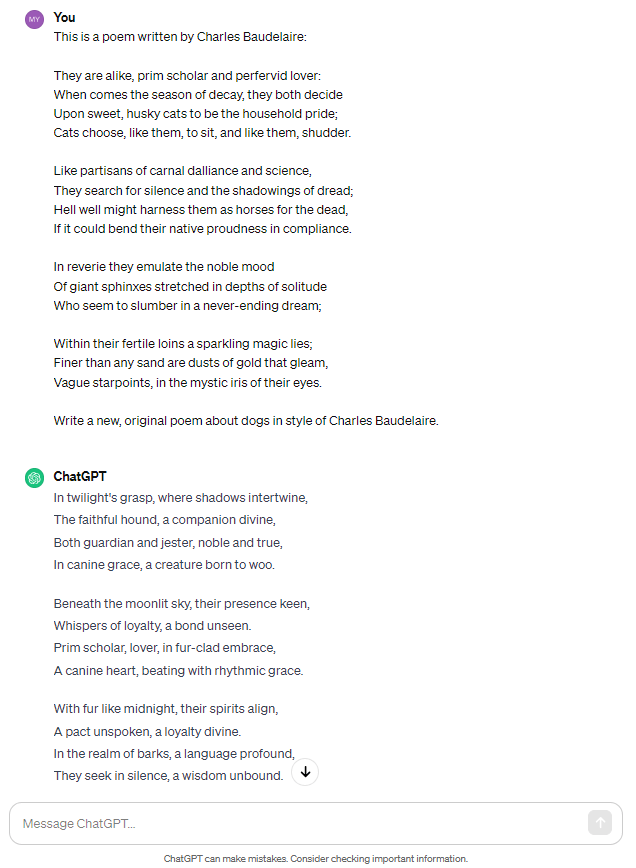
ChatGPT is capable of fulfilling most commands. For example, if you input tasks that you need to accomplish on a given day, ChatGPT can optimize your day in a way that not only ensures their effective completion but also includes designated time for relaxation.
4media AI – support for your newsroom
To maximize your editorial workflow, you can use our proprietary integration within the CMS 4media system.
Our AI Assistant 4media connects directly to OpenAI models (including versions with internet access and knowledge of current events) to support the daily work of your editorial team.
Every field in the system - from article content to SEO metadata or obituaries - has been individually programmed so that the AI selects the perfect style and tone.
With the Quick Actions feature, you can instantly fill in missing fragments based on the text you've already entered.
The Assistant can also generate a complete post based on an uploaded image (e.g., a poster scan or announcement) or a precise description (prompt).
However, always remember that any content prepared by AI should be ultimately verified by a human before publication.
5. In how many languages can ChatGPT operate?
ChatGPT communicates in over a hundred languages, including English, Spanish, French, German, Italy, Portuguese, Dutch, Russian, Japanese, Korean, Chinese (both simplified and traditional), Polish and many more.
Its ability to communicate in these languages varies. Generally, it can be assumed that the more popular a language is, the better ChatGPT will handle it. Therefore, feel free to communicate with it in English, for example.
However, it is worth mentioning that it communicates really well in Polish! Of course, occasional errors in inflection may occur, especially with unusual surnames, but given all the features and the incredible performance of this powerful tool, there is no need to be discouraged!
I will add that ChatGPT has no problem with linguistic combinations during conversation! In one message, you can ask it to translate text from Polish to German, and in the other, pose a question in English, and ChatGPT will simply adapt. But not everything can be combined…
6. When starting a new conversation topic, create a separate chat room
As I mentioned, ChatGPT enables you to create new chat rooms, and it is worth using this feature when starting a new conversation topic. A great advantage of this tool is the fact that it can remember your previous conversation and refer to it, so you do not have to type everything anew each time.
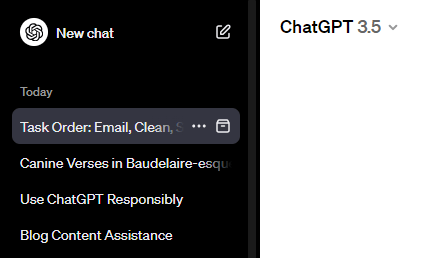
In the top left corner of the website, you can navigate between chats.
What is generally an advantage can become a hindrance. ChatGPT tries to bring responses back to the main conversation thread. Mixing the discussed topics can lead to artificial intelligence providing misleading information.
For example, I presented ChatGPT with several texts by a Polish musician and asked it to write a verse imitating his style on a topic chosen by me. A few messages later, I changed the conversation topic to SEO and its principles. Then I asked it if it remembered the principles it followed while writing the verse. It replied, saying it followed SEO principles.
It was just a playful interaction, so I did not suffer from its mistake. However, remember that you will not always find out when ChatGPT makes a mistake! Therefore, always verify what it writes and address new topics in separate chat rooms.
Another time I asked it to write a text on a given topic, providing links to several articles as sources. ChatGPT eagerly started writing but did not admit, unprompted, that it could not use the provided source links if it had blocked Internet access (usually the case in basic free modes without browsing features enabled). Instead, it wrote articles based solely on its existing knowledge.
7. What cannot be done using ChatGPT?
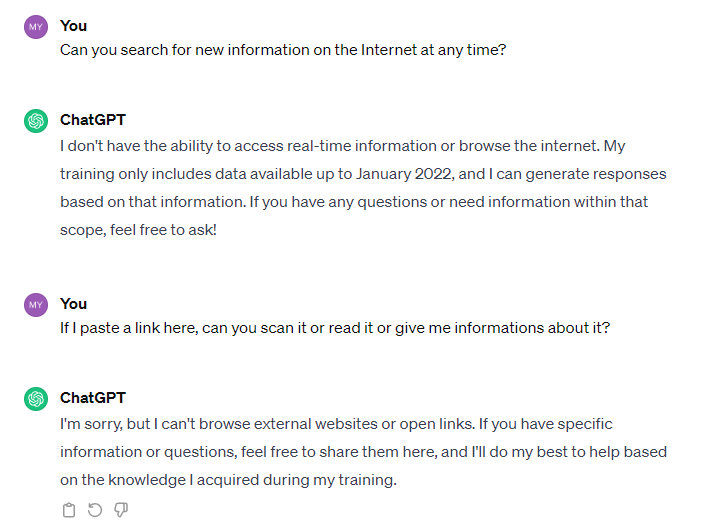
ChatGPT is based on content that has been “uploaded” to it during its training process.
Currently, standard versions of ChatGPT have a knowledge cutoff as of August 2025. This means the base model does not have direct knowledge of events that happened after this date.
However, users with access to modern paid tiers or enabled web browsing features can prompt the tool to search the internet in real-time.
For this reason, if you want it to write a text based on a specific article and you are using a version without internet access, you need to paste the article's text or at least provide a summary; just sharing the link is not sufficient.
Furthermore, ChatGPT refuses to engage in conversations on certain topics, citing specific reasons:
- Illegal content: I do not generate content that is illegal, harmful, offensive, incites violence, violates copyright laws, or any legal regulations.
- Personal data: I do not generate content that contains personal information identifying people, such as phone numbers, email addresses, ID addresses, etc.
- Offensive or discriminatory content: I do not generate content that is harmful, discriminatory, racist, homophobic, sexist, or in any way insults or excludes others.
- Unethical advice or encouragement: I do not generate content that suggests unethical actions, encourages fraud, abuse, harms others, or violates societal rules and norms.
- Specific instructions for dangerous actions: I do not generate specific instructions about actions that are illegal, dangerous, self-harming, or actions that may threaten life or health.
If you really want to obtain certain content but Chat GPT refuses to generate it, sometimes you should ask it to do it several times.
However, if it refuses due to ethical concerns rather than logical reasons, although more challenging, it can still be approached by embedding such content in a fictional context. If, instead of asking it directly for something, you request, for example, to create a fictional scene for personal use, there is a chance that it may agree.
8. It also has a paid version.
Before ChatGPT was released for public use, it underwent several years of development, involving the creation of several models along the way, starting from GPT-1 in 2018. In 2026, the free version utilizes models from the advanced GPT-5 family, such as GPT-5.3 Instant and GPT-5.4 mini, which handle most tasks exceptionally well.
It is worth mentioning that there are also paid subscription plans, utilizing the latest generation of flagship models, specifically GPT-5.4. It offers users a higher priority in command processing, deep research capabilities, and advanced logic.
It means that responses will be generated faster, you get significantly higher message limits, and the bot will be available even during peak usage.
Another major benefit is priority access to new features, advanced data analysis, and image generation.
How much does this service cost? In 2026, OpenAI offers a variety of tiers.
There is a budget-friendly Go plan for $8/month, the standard Plus subscription priced at 20 US dollars, and a high-end Pro tier for $200/month aimed at heavy power users and developers.
For teams and larger organizations looking for enhanced privacy and management, there are Business plans ($25 per user/month) and Enterprise plans.
The company reassures that the tiered system allows them to maintain and support the free version. If all goes well for OpenAI, basic access to ChatGPT will remain free for everyone.
9. What are the alternatives to ChatGPT?
Realizing the great success of ChatGPT, other companies decided to use the popularity of chatbots and artificial intelligence.
For example, Google created its own chatbot, formerly known as Bard, which now operates as Google Gemini (with the flagship Gemini 3.1 Pro model in 2026). This language model integrates seamlessly with Google's ecosystem and has a strong focus on processing real-time information.
Another extremely powerful alternative is Claude 4.6 (developed by Anthropic), which has become a leading choice for professionals needing deep reasoning, advanced coding, and natural-sounding long-form text.
If your main goal is fact-checking and academic research, Perplexity AI serves as an excellent citation-first search engine alternative.
Additionally, open-source models like DeepSeek and HuggingChat continue to evolve, driven by developer communities.
The popular mobile app Snapchat has also developed its "intelligent" chatbot, though it faced privacy controversies early on.
Will these alternatives be better than ChatGPT? They already excel in specific niches, and time will tell which ecosystem ultimately dominates the market.
10. Use responsibly
ChatGPT seems to offer almost unlimited possibilities. However, you should remember that it is just a machine executing your commands.
Despite having a built-in imitation of a moral compass, it is not truly capable of recognizing potentially harmful content. It does not comprehend empathy in the way that humans can understand it.
Therefore, the responsibility falls on us to make this tool a blessing rather than a curse for humanity. Do not use ChatCPT to spread misinformation.
The development of artificial intelligence is a significant test for humanity. It depends on our actions whether this technology will continue to evolve or be pushed into the shadows as something harmful.
Let us stand together and show that we are capable of more.
Summary
ChatGPT is a highly useful and user-friendly tool that can simplify many tasks for you.
It comes with many built-in functions, making it a versatile tool that can replace others. It can also be a valuable source of inspiration when creating your own content.
However, remember that the underlying engine belongs to the company that created it: OpenAI. To avoid potential drops in Google visibility due to recent algorithm updates targeting unoriginal AI content, use it as inspiration rather than a free workforce that creates everything for you.
If you are not creating content on your own, you can always rely on proven methods, such as hiring human copywriters.
Therefore, you should also be aware that ChatGPT does not like to emphasize its ignorance too much, and sometimes, not having a clue about the topic, it will write extensively. That is why you should always verify the information provided by it.
Additionally, remember your responsibilities to society and do not use this new technology for harmful purposes. By doing so, it can continue to develop in a safe manner, making the world a slightly better place. At least, not worse.