polski
 español


Google has built a velvet rope around the word "publisher."
Imagine a local newspaper that has dutifully covered city hall for 70 years. It employs six dedicated reporters, maintains a robust historical archive, and is the lifeblood of its community’s civic information. Yet, under Google’s latest framework, it might fail the test to be recognized with a dedicated Search Profile.
Meanwhile, a food review account launched just last year can breeze past the velvet rope simply by holding a large Instagram following.
That is how Google Search Profiles work in the United States today. Marketed to creators, brands, and publishers, these profiles offer a substantial reward: a customizable space connected directly to Search and Discover. Qualifying entities get the chance to shape a Knowledge Panel, pin posts, add direct links, and let readers follow their source right from the search results page.
But the gatekeeper isn't journalistic rigor or local impact; it's social media followers.
The Follower-Weighted Era
Historically, the fundamental unit of the web was the page. Today, the platform era’s new unit is the audience account.
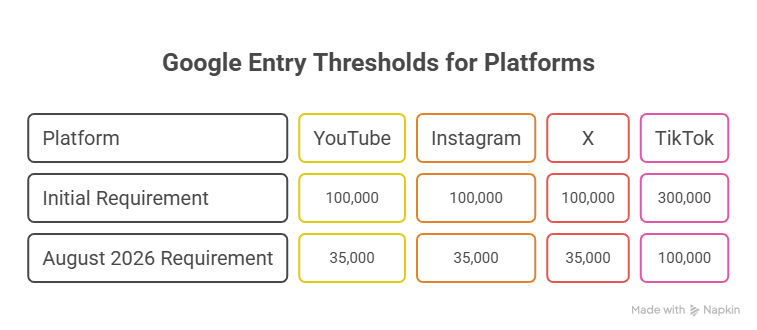
Initially, Google set the entry bar incredibly high: 100,000 followers on YouTube, Instagram, or X (formerly Twitter), or 300,000 on TikTok. While Google recently (August 2026) lowered these thresholds slightly for some platforms—dropping the requirement to 35,000 subscribers for YouTube, Instagram, and X (though keeping TikTok at 100,000)—the underlying philosophy remains unchanged.
This is follower-weighted legitimacy.
While Google explicitly states that creating a profile does not directly change search rankings, the implications for visibility are real. Users who follow a source via their Search Profile may see more of that creator's content surfaced in Google Discover.
For local publishers, this trend is a stark reminder: platforms evaluate worth through the lens of global scale, not local necessity. Google’s threshold tells us where its product is going. It should not tell a local newsroom what it is worth.
Why the Timing Matters (And What It Means for AI)
The push toward audience accounts comes at a critical juncture. As we've tracked in our recent coverage, including The Messenger Becomes the Author and Google Search Live and the End of Drive-By Traffic, publishers are facing an existential question: How much of our reporting should we keep feeding into AI search ecosystems as traditional referral traffic continues to fall?
Google is elevating social accounts to first-class properties inside Search Console, accommodating creators who might not even own a traditional website. This shift underscores a broader industry pivot: reliance on third-party platform traffic is becoming a losing game for hyper-local entities.
The Strategy for Local Newsrooms: Audience Sovereignty
Local publishers cannot afford to play by "national creator math." Instead, they need a two-pronged approach:
1. Claim Every Available Surface If your newsroom meets the new 35,000 follower threshold on a platform like X or Instagram, claim your Google Search Profile immediately. Optimize it, pin your best investigative work, and use it as a funnel. Play the game where you can.
2. Build What Platforms Cannot Revoke The ultimate defense against shifting algorithm thresholds is Audience Sovereignty. Local publishers must relentlessly build direct relationships with their readers.
This means prioritizing:
- Direct website readership
- First-party data collection
- Paid subscriptions and paywalls
- Owned newsletters
Platforms can change the rules of the velvet rope overnight. They cannot take away a loyal subscriber who visits your homepage directly or opens your morning email.
How CMS4media Supports True Independence
Building a sustainable local news model requires the right infrastructure—one that doesn't rely solely on algorithmic goodwill. This is where moving beyond a basic website to a comprehensive publisher platform becomes vital.
CMS4media is designed specifically to help publishers build that unshakeable direct audience.
- First-Party Revenue Streams: Rather than waiting for platform payouts, CMS4media allows publishers to easily implement Paywalls & Subscriptions, establishing a direct financial relationship with readers.
- Engagement Tools: Modules like the Content Hub and Quizzes keep readers on your site longer, turning casual visitors into habitual readers.
- Sovereign Monetization: With built-in features for a Classifieds marketplace, Business directory listings, and seamless integration with the Ads4media network, local newsrooms can diversify their revenue away from programmatic display ads and build local business partnerships.
- AI Efficiency: The built-in AI Assistant helps resource-strapped newsrooms optimize content for SEO and generate related materials quickly, ensuring that when you do compete for search traffic, your content is perfectly primed.
The Bottom Line
Google’s evolving Search Profiles are a fascinating tool for creators with mass appeal, but they expose a blind spot when it comes to the vital role of local journalism. A local publisher's worth is defined by the community it serves, not an arbitrary follower count.
By focusing on direct readership and utilizing tools designed for independent media growth, local newsrooms can ensure they remain the indispensable town crier, regardless of who is allowed past Google's velvet rope.