polski
 español


Suppose a local hardware store buys a featured listing in your newspaper’s business directory. Keep the invoice. If the owner buys another six months, keep that invoice, too. The first tells a funder your sales team can sell the idea. The second tells them what one customer chose to do after trying it. A year of those decisions is the beginning of an answer to the question on the funding form: How does your newsroom earn money?
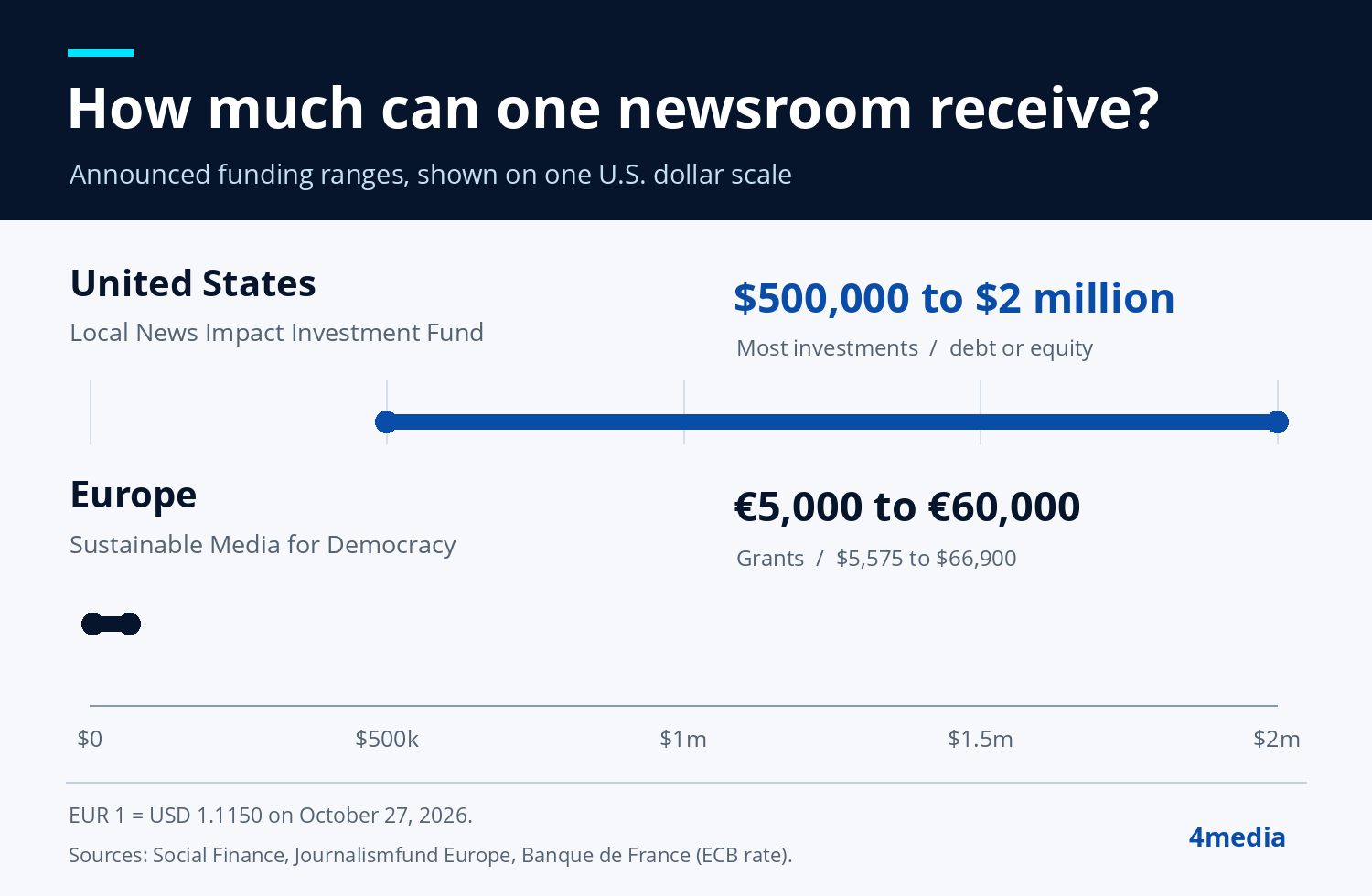
Two announcements in October give that question some urgency. On October 26, Journalismfund Europe, International Media Support and Reporters Without Borders announced Sustainable Media for Democracy (SM4D). A day later, Social Finance announced the Local News Impact Investment Fund in the United States. Both want local reporting to survive. They put their money to work in different ways. European announcement · U.S. announcement.
What the $21 million U.S. fund is looking for
MacArthur and Knight are the anchor funders. Press Forward and Social Finance also contributed to the initial $21 million in commitments. Social Finance expects most investments to range from $500,000 to $2 million. Independent U.S. nonprofit and for-profit outlets can qualify. The fund looks for publishers that know their audience and can explain how they intend to grow revenue and reach profitability. Social Finance’s investment criteria.
Social Finance now specifies that it can use both debt and equity. It plans to track each newsroom’s financial health and its impact on the community. If your paper wants to expand coverage into the next county, that gives you two questions to prepare for. Which reporting will residents there gain? What have readers or advertisers in your current market already paid for that you could sell in the next one? For a loan, take that calculation one step further: when would the expansion generate enough cash to make the payments? How the U.S. fund works.
What Europe’s €1.625 million buys
SM4D plans to award €5,000 to €60,000 per outlet to about 45 news organizations over a 24-month program. It focuses on local, regional, community and investigative media serving news deserts or places where people have few independent sources of news. The European Union’s Creative Europe program and the Limelight Foundation are co-funding the initiative. SM4D grant amounts and geography.
Selected outlets will also work with peers and advisers on subjects including audience development, business models and access to capital. Journalismfund Europe says it will publish the full eligibility criteria with two calls in December. Its introductory webinar is scheduled for December 2 at 2 p.m. CET. For a U.S. newsroom, this is a European comparison. U.S.-based outlets fall outside SM4D’s published geographic eligibility. Webinar details · Eligible countries and call schedule.
What belongs on a publisher’s one-page revenue summary?
Piotr Marek, CEO of 4media, suggests writing the business-model page while you have the books open. Pick the last 12 complete months and the 12 before them. Give each source of income its own row: subscriptions, advertising, directory listings, events, donations and grants, as applicable. Use the same accounting basis for both periods. Circle the line that grew. Then explain what drove the change.
For a business directory, separate first-time purchases, renewals and price increases. A higher price can lift sales even if fewer businesses come back. For renewals, use as your denominator the advertisers whose listings actually expired during the period. Beside those figures, put the staff time it took to sell and service the listings. That gives you a basis for deciding whether adding a salesperson or expanding into another county makes economic sense.
Finish with one sentence you can defend: “Of the businesses whose listings came up for renewal, ___ of ___ paid for another term. Those renewals brought in $___, according to our paid invoices.” This is a working note for the publisher. Each fund sets its own requirements.
Where the CMS fits
CMS4media’s Business Directory lets a publisher give each business a page and charge for extras such as a longer listing or a set number of days on the homepage. That gives the sales team something specific to offer the hardware store. The published listing shows what the paper delivered. The invoice and payment record show what the customer paid. Match those records over a year and you have something more useful in a funding conversation than a screenshot of traffic. See how the Business Directory works.
If directory sales are the revenue line you want to test, bring one offer from your rate card to a CMS4media demo. Ask us to show you what the owner would buy and where a reader would see it. Talk to the 4media team.