polski
 español


When a publisher with more than a decade of history moves six live news portals onto a new platform, the question is never "does the software look nice." The question is "will I lose my traffic, my archive, and my readers on the way." Przemysław Hartmann had carried that exact worry for years. Here is what happened when he made the move to CMS4media.
Key results at a glance
- 6 portals migrated to CMS4media, live since April 1, 2026
- Google Discover traffic up close to 41 percent month over month
- Google News traffic up 14.9 percent
- Organic search traffic retained through the migration, with no meaningful drop
- The Koronowo portal grew from roughly 90,000 to roughly 115,000 monthly users, and now stays consistently above 100,000
- Editorial team productive on the new system within about 5 days
Who this is about
Przemysław Hartmann runs Hartmann Media Consulting, the business formerly known as the Kujawy Media Group. The company has been on the market for about 12 years, and his flagship title, mojakruszwica.pl, just passed its 12th anniversary. He publishes across a cluster of local sites in the Kujawy region of Poland, including portals in Koronowo, Strzelno, and Janikowo, each serving a different small-town audience with different interests.
He did not start as a software person. He started as a journalist and editor, then grew into a publisher when it became clear the business had to be run as a business, not just a place to post news. That background matters, because it makes him exactly the kind of reader this case study is written for: a hands-on local publisher, not an IT department.
The starting point: two kinds of pain
Hartmann had been through several content management systems before CMS4media, and the history was not happy.
In the early years, his team ran home-grown, frankly amateur solutions. He remembers the "blood, sweat, and tears" of that first portal, a site that broke down often and left him and a partner to fix every problem alone, with no one to call.
His most recent provider solved the "build it yourself" problem but introduced a new one: advertising. Heavy, resource-intensive ads were getting between readers and the content. Readers complained. As he put it, people today expect straightforward access to a story, not a page that makes them wait while ads stack up. When a page takes several seconds to load, the bounce rate climbs, because almost no one is that patient anymore.
There was also a fear that keeps many independent publishers out of any network: the worry about losing independence and having someone interfere in the newsroom workflow. Looking back, he says that fear did not come true.
The part every publisher dreads: migration
Migration is the moment publishers lose sleep over, because it puts the archive and the search traffic at risk at the same time. Hartmann faced a real decision on each site: migrate the full database, or archive it and start clean. On some portals his team archived the old database. On the heavier sites, including Koronowo and Kruszwica, they migrated the entire archive, years of articles, photos, and metadata.
A migration at that scale is not a one-click event, and the honest version of this story includes that fact. After go-live, the portals were checked with a post-migration audit on the 4media side, and the work also included an independent SEO audit of the result. That review drives a prioritized cleanup of the usual long-tail migration issues, things like setting 301 redirects on the highest-traffic legacy URLs, retiring an old service worker left over from the previous setup, and resolving indexing notifications from Google, with follow-up checkpoints in Google Search Console to measure each fix. None of that is glamorous, but it is the difference between a migration that holds and one that quietly leaks traffic for months.
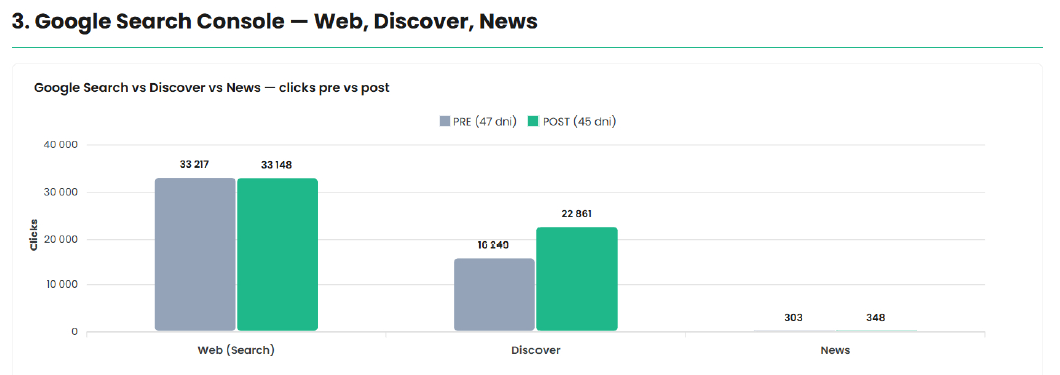
The aggregate result, which Hartmann read out himself on camera, was the part that mattered to him. Google Discover grew by close to 41 percent. Google News grew by 14.9 percent. Search traffic was effectively held in place rather than collapsing. Old broken links from the previous system stopped being a problem. (See roughly the 19:25 to 23:00 mark in the interview.)
He is also candid about the human side. Some traffic loss always happens at first, because readers have to get used to a new site, and reactions are mixed in the first weeks. April was a test month. By June he could see the numbers settling and then climbing. The Koronowo portal, his most representative site, moved from around 90,000 monthly users last summer to around 115,000, and now holds above 100,000. Crucially, that growth was not only local readers, which was a specific goal for a portal based in a very small town.
What changed in daily work
Speed came first. The heavy, intrusive ads are gone, and the site stays fast even when it is carrying a lot. Hartmann stress-tested this by pasting in HTML-heavy material, building an entertainment zone, even embedding a game. On his old setup that would have dragged the whole template to a crawl. On CMS4media it did not freeze or slow the page.
Then came the breadth of the platform, which he describes not as a place to add articles but as a full "media environment." A few modules stood out in his daily use:
- The Classifieds module finally gave his listings a place to be promoted, and reader interest in them took off in a way the old template never allowed.
- Quizzes and other engagement modules keep readers on the page and coming back.
- Photo galleries became a real tool rather than a dump of images. He tests different formats against his audience, including the hybrid gallery that shows a few photos and then prompts a click-through, and the scroll-based cascade gallery, trading off between time on page and page views.
- Related Articles let him link stories together and resurface older material from the archive, which keeps readers moving through the site.
For a publisher running six titles, the multi-site capability is the quiet hero. He can manage and share content across portals from one place. His early fear was that sharing the same content across sites would get him penalized by Google for duplicate content. It does not work that way here, because the system points the duplicates back to the source portal, so the main site is the one that benefits and SEO is not hurt. That means a story that fits two towns does not have to be written twice.
He is also testing the platform's AI assistant, which generates suggested titles, tags, and SEO-oriented material, and lets him set tone and format. For quick news, where typing tags by hand is a chore, it works instantly. He was wary of the common claim that AI tools hurt a portal's ranking, and his experience is that they speed up the work without that downside. Behind the assistant sit more than 70 prompts and a different model matched to each module, which is the reason it behaves sensibly rather than generically. (See roughly the 24:00 to 26:00 mark.)
The "free CMS" question
Plenty of small publishers start on a free CMS and never want to add a cost. Hartmann understands that instinct, and he pushes back on it from experience. After more than a decade online, his view is blunt: there is no good software that is truly free. Someone has to recover the cost, and with a free CMS they usually recover it by cluttering your pages with the very ads that drive readers away. In an era when publishers already have to fight social platforms for every visit, paying that hidden tax in ad clutter is, in his words, not worth it. He would rather pay a subscription for a stable, professional, flexible system and run a portal he is proud of. He moved six sites over knowing that meant real cost. (See roughly the 14:30 to 16:30 mark.)
On the revenue side, 4media supplies ads and sponsored articles, and the two sides split ad profit 50/50. What impressed him was the transparency: the ad report was clear and detailed rather than a black-box number in a Word document, he could see where the amounts came from and how engagement fed into them, and when he sent follow-up questions he got specific answers. The contract itself was negotiable, adjusted along the way to fit how he works.
The FREE Trap You Never Knew Existed
Onboarding and support
A powerful system raises a fair fear: will it be too complex to use. Hartmann's first reaction was exactly that, a large system and the worry of figuring it out. In practice it took about five days, maybe less, to feel at home, helped by four or five solid training sessions. His verdict is that the system is extensive but it makes sense, and that drag-and-drop content handling makes everyday publishing genuinely pleasant.
Support is the other half. He felt, especially during the migration, that the team was essentially at his disposal, to the point he worried he was leaning on them too much. When Google flagged indexing issues, he got help getting the archive indexed and available. When an ad-provider glitch surfaced content that should not have appeared, that got resolved too. Beyond day-to-day contact with the team, there are quarterly roadmap meetings where publishers can raise ideas for what gets built next.
What comes next
Part of why Hartmann recommends the platform is that the runway keeps going. He can cover live events, add audio and radio streams, and is preparing an e-edition, a PDF version of his printed newspaper sold behind a paywall, alongside plans to move his radio onto the portal so people can hear the local news there too. For a publisher who also prints, that combination of print, web, and audio under one roof is the point. As he sums up the platform's flexibility, "basically nothing limits us now."
Would he recommend it to other publishers?
Yes, without hesitation. After nearly three months he says it works the way it should and makes sense, the team has ideas for the future, and the experience extends beyond Poland, including publishers in the United States and the server-side solutions behind them. For any publisher, in print or online, looking for serious, professional tools, his advice is simple: it is worth a conversation, and worth testing. (See roughly the 28:00 mark.)
Frequently asked questions
Will I lose my SEO or search traffic if I migrate my news site? Migration always carries risk, and some short-term wobble is normal as readers adjust. In this case, organic search traffic was retained through the move, while Google Discover rose by close to 41 percent and Google News by 14.9 percent, supported by a post-migration audit and a prioritized cleanup of legacy redirects and indexing issues.
Is a paid news CMS worth it compared to a free one? This publisher's view, after more than a decade online, is that no capable software is truly free, and that free systems often recover their cost by loading your pages with intrusive ads that cost you readers. He chose to pay for a stable, flexible, professional platform instead.
Can I manage several local sites from one place without a duplicate-content penalty? Yes. The multi-site capability lets you publish and share content across portals from a single admin, and shared content points back to the source portal, so the main site benefits and search rankings are not harmed.
How long does it take to learn the system? For this team, about five days to feel comfortable, supported by four or five training sessions and ongoing support.
Does using the AI assistant hurt my SEO? In this publisher's experience, no. The assistant generates titles, tags, and SEO material and speeds up routine work, with a different model matched to each module rather than one generic engine.